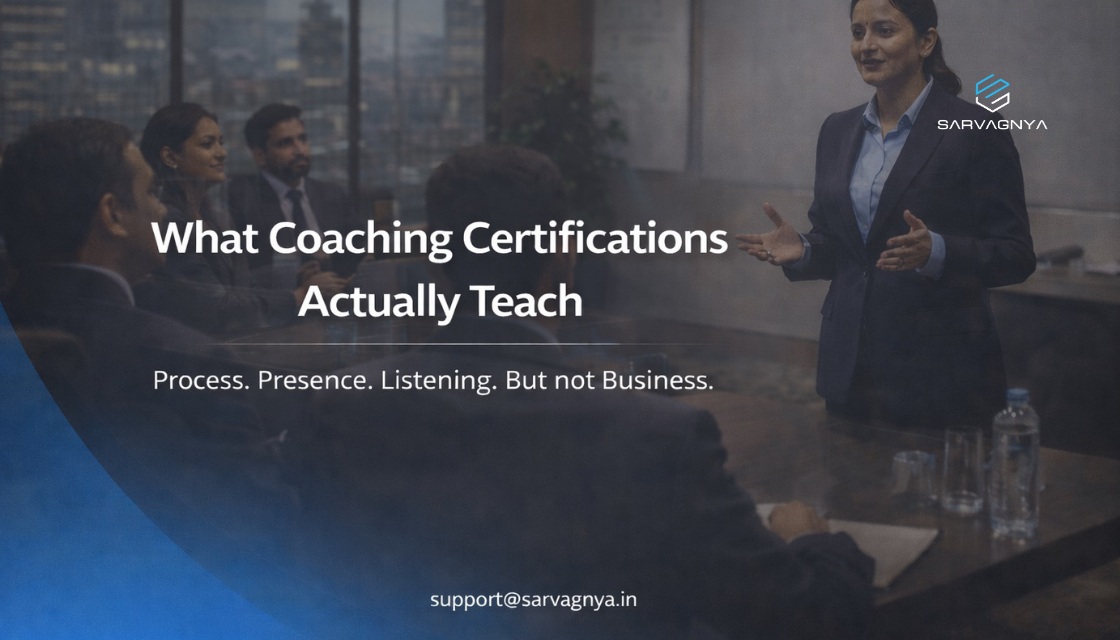
What Coaching Certifications Actually Teach
Let me be precise here, because this is often misunderstood — including by coaches themselves.
ICF, EMCC, and equivalent credentialling bodies have built rigorous, evidence-based frameworks for what good coaching looks like. The ICF's eight core competencies — ethical practice, coaching mindset, active listening, evoking awareness, facilitating growth — represent a genuine standard for the quality of a coaching conversation.
These frameworks teach you how to coach. They build listening discipline, presence, the ability to hold space without judgment, and the skill of asking questions that open thinking rather than close it.
What they were never designed to teach — and what they explicitly do not teach — is business.
A coach completing an ICF-accredited program will graduate knowing how to facilitate a powerful conversation. They will not graduate knowing how to read a P&L, diagnose an organizational system under stress, or help a leader think through the execution architecture behind a three-year strategy.
This is not a criticism of ICF. It is a description of its scope. The credential does exactly what it promises. The problem arises when coaches — and the organisations that hire them — mistake the credential for the complete qualification.
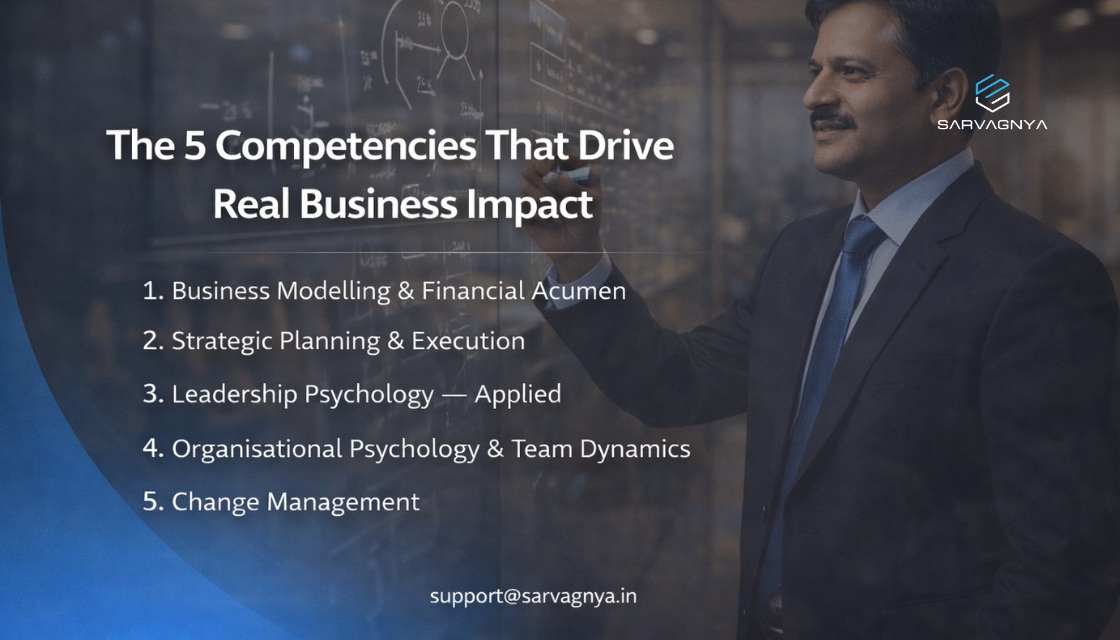
The Five Competencies That Drive Real Business Impact
In over thirty years of working with senior leaders, C-suite executives, and entrepreneurs across India and eleven other countries, I have observed a consistent pattern. The coaching engagements that produce genuine, visible, business-level change share a common thread: the coach brings five competencies that no certification program teaches.
1. Business Modelling and Financial Acumen
India's corporate landscape is dominated by promoter-led businesses, family conglomerates, founder-run startups, and rapidly maturing GCCs. In every one of these contexts, the leader is the strategy. Their decisions about capital allocation, revenue architecture, pricing, and cost structure are inseparable from their leadership behavior.
A coach who cannot hold an intelligent conversation about business models cannot be genuinely useful at this level. They can help the leader feel clearer. They cannot help the leader think better about the actual problem.
2. Strategic Planning and Execution Literacy
Senior Indian leaders operate under relentless pressure to deliver against Annual Operating Plans, board mandates, and investor expectations. The gap between strategic intent and operational execution is one of the most common leadership failure points — and it is fundamentally a behavioral problem as much as a structural one.
A coach without fluency in strategic frameworks cannot help a leader diagnose why their organisation keeps failing to execute. They can explore the leader's mindset around accountability. They cannot map the system that is producing the accountability failure.
3. Leadership Psychology — Applied, Not Theoretical
India's high power-distance culture creates a specific leadership pathology. Senior leaders are admired, deferred to, rarely challenged, and consequently prone to blind spots that compound over time. The people around them manage up rather than speak up.
Understanding leadership psychology — not as an academic subject but as a live diagnostic tool — is what allows a coach to name what they are observing, help the leader recognise patterns they cannot see in themselves, and create the conditions for genuine behavioral change. This requires more than coaching presence. It requires a working knowledge of how leadership styles function under pressure, what drives defensive behavior, and how identity and role interact at senior levels.
4. Organisational Psychology and Team Dynamics
When a coach works only with the individual in front of them, they are solving for one node in a complex system. The leader returns to the same team, the same meeting culture, the same informal power dynamics — and the behavioral change achieved in coaching sessions does not survive contact with organisational reality.
Understanding group development, team dysfunction patterns, psychological safety, and how culture manifests as behavior is what allows a coach to work with the system rather than in spite of it. In India, where the interplay of hierarchy, generation, gender, and regional identity creates layered organisational complexity, this is not optional expertise. It is foundational.
5. Change Management
India is in the midst of deep organisational transformation. Businesses are professionalising. Founders are transitioning. Family businesses are navigating succession. GCCs are evolving from execution centres to strategic hubs.
Every one of these contexts demands a leader who can drive change — and a coach who can work with that leader at the precise intersection of personal development and organisational transformation. A coach without change management literacy can support the individual. They cannot support the organisation.
Why This Gap Is Particularly Acute in India
Three structural realities amplify the impact of these competency gaps in the Indian context.
The hierarchy problem. In high power-distance organisations — and India scores among the highest globally on this dimension — feedback flows poorly upward. Leaders receive filtered information, carefully managed narratives, and curated updates. A coach working only with the leader's self-reported experience is coaching in an information vacuum. The leader may believe they are transforming. Their team may be experiencing something entirely different.
The measurement void. In India, where coaching budgets are scrutinised and ROI justification is required, the inability of most coaches to demonstrate measurable behavioral change at the business level is a fundamental commercial and credibility problem. Satisfaction surveys measure the quality of the coaching experience. They do not measure whether anything changed in how the leader leads — or whether that change was noticed by the people it was meant to affect.
The last-resort pattern. Coaching in India is too often deployed as remediation rather than development — initiated after a performance review has flagged a problem, or as a final intervention before a difficult talent decision. In this context, even a skilled coach is working against the current. Without business depth and organisational understanding, they have very little chance of turning it around.
The Solution: Stakeholder-Centered Coaching
I want to offer not just a diagnosis but a specific, proven methodology that addresses the core of this problem.
Marshall Goldsmith's Stakeholder-Centered Coaching (MGSC) is the most rigorous answer I have encountered to the question of how to make coaching demonstrably, measurably impactful in complex organisational contexts.
The central principle is deceptively simple: a leader's effectiveness is not determined by the leader. It is determined by the people around them.
In practice, this means that the coaching engagement does not begin and end in a confidential room between coach and coachee. It deliberately and systematically involves the stakeholders — direct reports, peers, the leader's manager, sometimes board members — in identifying the behavioral changes that will have the greatest organisational impact, and in tracking whether those changes are actually happening.
This is not 360-degree feedback as most organisations know it — a one-time data collection exercise that produces a report and is then filed away. MGSC makes stakeholder engagement an ongoing, iterative, monthly process across a twelve-month engagement. Stakeholders provide regular feedforward — not criticism of past behavior, but practical suggestions for future improvement. They participate in mini-surveys at structured intervals that measure whether the leader's behavior, as they experience it, is actually shifting.
The result is something that very few coaching methodologies can claim: independently verified, stakeholder-validated evidence of behavioral change.
For India specifically, this methodology resolves several of the structural problems described above.
It breaks through the hierarchy barrier. By formally involving stakeholders in the coaching process, MGSC creates a structured channel for honest feedback in organisational cultures where informal feedback is suppressed. The process creates psychological safety for stakeholders to contribute — and it gives the leader permission to receive feedback without defensiveness, because it is framed as development rather than evaluation.
It solves the measurement problem. The Mini-Survey tool produces quantifiable data on perceived behavioral change — data that HR leaders, CFOs, and boards can look at and evaluate. This is not self-reported insight. It is stakeholder-reported evidence.
It changes the organisational system, not just the individual. When a leader goes public with their development goals and actively involves their team in tracking progress, something shifts in the culture around them. Team members who contribute to a leader's growth become invested in it. The coaching engagement becomes a catalyst for broader cultural change — which is ultimately what organisations in India are paying for, even when they don't articulate it that way.
Study after study on MGSC engagements shows that 95% of leaders using this process improve their effectiveness as measured by their stakeholders. This is not a claim about coaching satisfaction. It is a claim about observed behavioral change.
What This Means for Coaches, Leaders, and Organisations
For coaches: A credential is your entry point, not your destination. The coaches who will build lasting practices in India are those who pair coaching discipline with genuine business depth — who can speak the language of strategy, organisational behavior, and change management, and who can deploy structured methodologies that produce evidence of impact. Pursue your ICF credential. Then go further.
For senior leaders and CEOs: When you engage a coach, ask harder questions. Not just: what is your methodology? But: have you ever run a P&L? Do you understand organisational systems? How will we know, twelve months from now, whether this worked? The quality of the answer will tell you more than the letters after the name.
For HR leaders and CHROs: Coaching is not a benefit. It is a business intervention. Commission it like one. Define the behavioral outcomes you need. Build in measurement from day one. Insist on methodologies that involve stakeholders — not just the individual being coached. And evaluate coaches on their ability to understand your business, not just their ability to hold a good conversation.
Closing Thought
The coaching profession in India is at an inflection point. The market is growing. The demand is real. The opportunity to make a genuine difference in how Indian organisations develop their leaders has never been greater.
But growth without quality is not progress. It is noise.
The coaches who will matter — to their clients, to their organisations, and to the profession — are those who have the honesty to look at their own competency gaps and the discipline to close them. Who understand that a credential proves you know how to coach, and business depth proves you're worth the investment.
India's leaders deserve coaches who can sit with them at the table where real decisions are made.
Not just as a sounding board.
As a thinking partner who understands the terrain.