The Networking Event That Started Everything
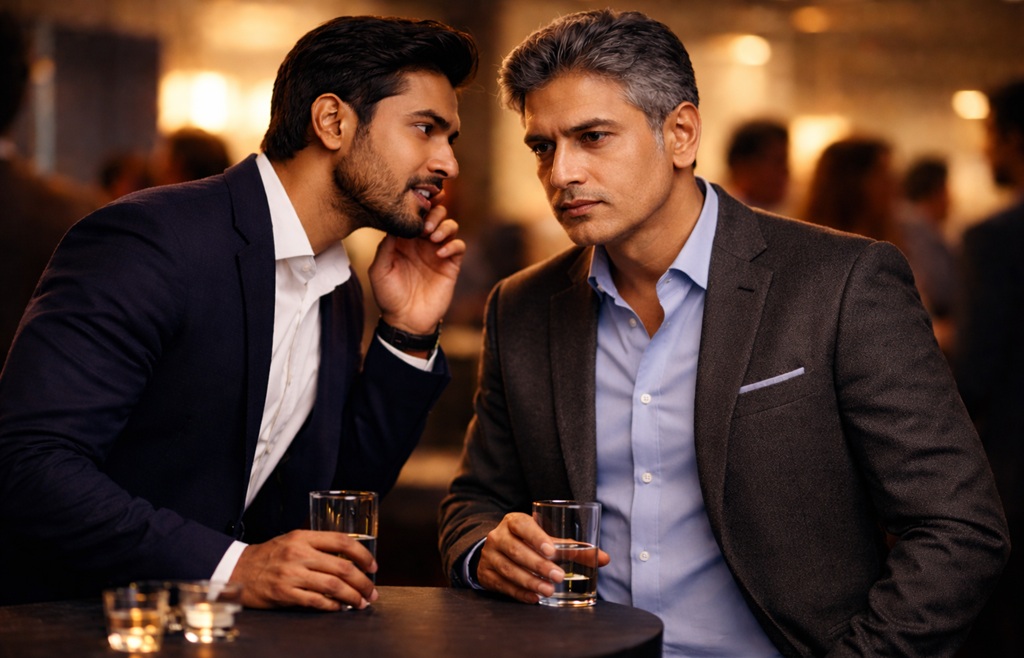
I met him at a networking event. One of four co-founders of a fast-growing company. He pulled me aside quietly and told me their founding team was fracturing — split into two camps. And that the main co-founder, he said, was the problem. Too dominant. Too controlling. A roadblock.
He wanted to know if I could help unify them. I said — bring all four of you to my Entrepreneur workshop. Let's start there. They came.
All four. And something unexpected happened.
After the workshop, it was the so-called "problem" co-founder — the dominant one — who approached me first. He looked at his co-founders and said he wanted group coaching. Not to defend himself. Not to win an argument. But to bring leadership alignment to a company that was pivoting fast and needed all four of them pulling in the same direction.
That moment told me everything I needed to know about who he really was.

What The Assessments Revealed
Before I could coach them, I needed to understand them.
I administered two assessments with all four co-founders — the Entrepreneurial EDGE and the Sarvaguna Indicator.
The Entrepreneurial EDGE is a world-class psychometric tool that profiles entrepreneurial talents across multiple dimensions — vision, risk orientation, drive, resilience, delegation, and execution capability.
The Sarvaguna Indicator, a proprietary tool I developed over decades of coaching founders and leaders, profiles behavioural traits, personality fit, and leadership style at a deeper level.
What came back was illuminating — and uncomfortable.
The main co-founder — the so-called "problem" — scored exceptionally high on client focus, execution drive, pragmatism, and business acumen. His profile was that of a classic builder-leader: someone who creates value through relationships, instinct, and the ability to attract and retain clients.
The other three co-founders presented very differently. Strong early-stage contributors — creative, energetic, useful in the startup phase. But their profiles revealed a fundamental mismatch with where the company now was. The business had scaled. The market had evolved. And their entrepreneurial capabilities had not kept pace.
The clashes I was witnessing in the room were not strategic disagreements.
They were the natural friction between a founder who had grown with his company — and three co-founders who hadn't.

The Real Problem: Five Fractures Beneath The Surface
As the individual and group coaching sessions deepened, five fundamental fractures emerged — each one invisible to the co-founders themselves, but unmistakable to an objective coach with the right diagnostic tools.
Fracture 1: Divergent Vision
Each co-founder had a different picture of where the company was going. Not slightly different — fundamentally different. One wanted to scale aggressively and attract institutional investment. Another wanted to stay lean and protect margins. A third was focused on a geographic expansion the others had never agreed to. These weren't positions arrived at through debate. They were privately held assumptions — never surfaced, never tested, never aligned.
A shared vision is not a poster on the wall. It is a living, specific, debated, agreed-upon picture of the future that every founder can articulate in the same words. This team had none.
Fracture 2: Equity That No Longer Reflected Contribution
The main co-founder had made a generous early decision — equal equity for all four founders in recognition of their contributions to the company's initial growth. At the time, it was fair. But companies grow. And the person who was invaluable at the seed stage can become a bottleneck at scale.
The three co-founders were now drawing equal ownership in a company built largely by the main co-founder's competence, client relationships, and the capable team he had assembled beneath the founding layer. The team below the directors was outperforming the directors above them.
Equal equity without evolving contribution is not fairness. Over time, it becomes one of the most corrosive forces in any founding partnership.
Fracture 3: Ego Masquerading as Strategy
In every session, disagreements were framed as strategic differences. But underneath the language of strategy was something more primal — wounded pride, territorial behaviour, and the need to be seen as significant.
I have coached hundreds of founders. I have learned to tell the difference between genuine strategic disagreement and ego in disguise.
Ego protects itself. It dresses itself in the language of principle and vision. But it always — always — prioritises being right over being effective.
Fracture 4: No Shared Accountability
The founding team had no mechanism for holding each other accountable. Commitments made in meetings evaporated between meetings. Responsibilities were claimed but not delivered. Client problems that required a unified response were met instead with deflection and blame.
Leadership culture in any organisation starts at the top.
When the founding team doesn't model accountability — the entire organisation learns that accountability is optional.
Fracture 5: Founders Who Had Stopped Growing
The company was growing. The market was rewarding them. Revenue was climbing. But demand-driven growth is deceptive — it masks the gap between what a company needs from its leadership and what its leadership can actually provide.
Three of the four co-founders had stopped investing in themselves. They had not developed the new skills — financial acumen, strategic thinking, client acquisition, investor communication — that the next phase of growth demanded. They were operating with a startup toolkit in a scale-up environment.
Founders who don't develop as their company develops become fossils in their own creation.

The Coaching Intervention: Building What Was Missing
Once the fractures were clearly diagnosed, the coaching work shifted from exploration to construction. Working closely with the main co-founder — who had the clearest vision and the strongest commitment to growth — I introduced a structured framework to rebuild the company's strategic foundations.
The Balanced Scorecard
We used the Balanced Scorecard framework to align the entire organisation around four strategic dimensions — Financial, Customer, Internal Processes, and Learning & Growth.
For a founding team with divergent agendas, the Balanced Scorecard served a second powerful purpose: it forced every co-founder to articulate their priorities in measurable terms.
When you have to express your vision as specific objectives, initiatives, and KPIs — it becomes immediately visible where alignment exists and where it doesn't.
The gaps that emerged during this exercise were the most honest conversation the four co-founders had ever had.
The 12 Building Blocks of Business Strategy
I worked with the main co-founder on a comprehensive business model rebuild using my proprietary 12 Building Blocks framework — covering value proposition, customer segments, revenue architecture, cost structure, key partnerships, operational model, sales channels, and competitive positioning.
This gave him something his co-founders had never provided — a rigorous, documented strategic foundation that could guide decisions, attract investment, and communicate the company's direction clearly to clients, partners, and potential investors.
Strategic Financial Planning
One of the most significant capability gaps we addressed was financial literacy at the leadership level. We built a strategic financial planning framework — moving the main co-founder from reactive financial management to forward-looking scenario planning, cash flow strategy, and investment-readiness.
Market Positioning & Client Acquisition
We worked extensively on positioning — defining clearly what the company stood for in its market, what differentiated it from competitors, and how to articulate that differentiation in client conversations. Alongside this, we built structured client acquisition strategies aligned to the company's strengths and the main co-founder's natural relationship-building capabilities.
Investor Presentation Capability
As the company's ambitions grew, so did the need to communicate effectively with investors. We developed the main co-founder's ability to construct and deliver compelling investor presentations — building the narrative, the financials, and the strategic story that institutional investors need to hear.

The Decision to Stop — And The Roadmap Forward
Despite the robust strategic work, the group coaching reached a point of diminishing returns.
The three co-founders were not changing. The behavioural patterns revealed in their assessments — the ego, the resistance to feedback, the unwillingness to take accountability — had not shifted meaningfully. The sessions were consuming energy that the main co-founder needed for running and growing his business.
I made a difficult recommendation: stop the formal coaching engagement.
Not because the business had failed. It was growing strongly. But because no coaching process — however rigorous — can create change in people who have decided not to change.
I presented the main co-founder with a clear roadmap and two strategic options for the path forward. Both involved a fundamental restructuring of the founding partnership. One was a negotiated separation. The other was a phased restructuring of roles and equity. Both required courage.
Then I stepped back.

Two Months Later
He called. He had chosen the path of negotiated separation — and implemented it with discipline, fairness, and decisiveness. Each co-founder was given a settlement. The split was clean. The company's team of 100+ people were given the choice of which entity to align with. Clients too were given the choice.
The verdict — from the team and from the clients — was decisive and overwhelming.
He rebuilt the leadership structure around capability, not history. He hired for the next phase of growth, not the last one. He continued applying the strategic frameworks — the Balanced Scorecard, the 12 Building Blocks, the financial planning and positioning work — with discipline and consistency.
Three years after that first conversation at the networking event, the business had scaled exponentially.
What Every Founder Must Know About Co-Founder Conflict
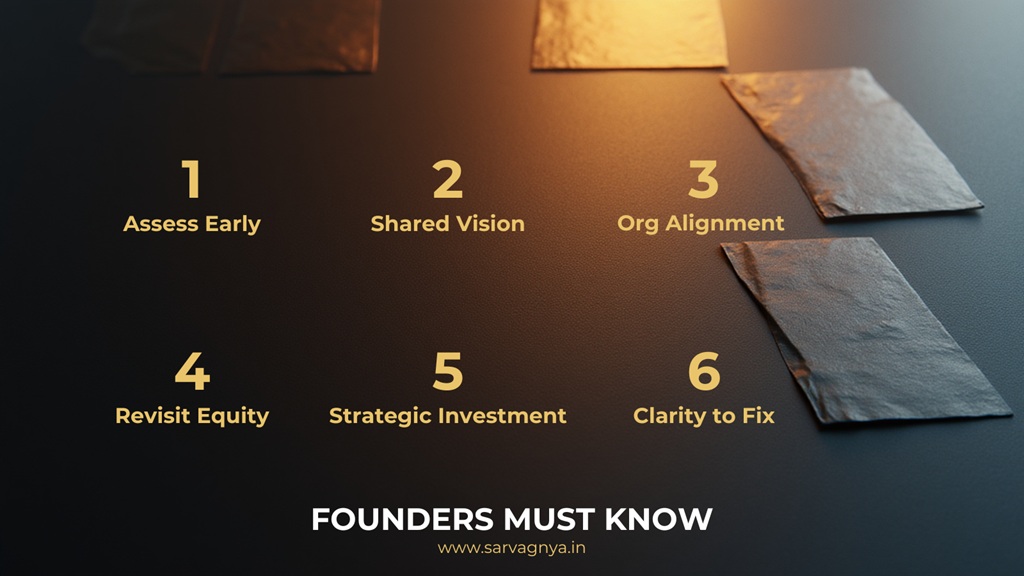
This story is not unique. In my three decades of coaching entrepreneurs across India and globally, co-founder conflict is one of the most common — and most costly — challenges I encounter. Here is what I want every founder to take from this story:
- Get your founding team assessed early. Psychometric tools like the Entrepreneurial EDGE and Sarvaguna Indicator exist precisely to surface what human beings hide — from others and from themselves. Profile your co-founders' personalities, entrepreneurial fit, and behavioural tendencies before conflict forces you to. The investment is minimal. The insight is invaluable.
- Build a shared vision — explicitly, specifically, and in writing. A shared vision is not a feeling. It is a documented, debated, agreed-upon picture of the future that every founder can articulate in the same words. If your founding team cannot do that today — start there. Everything else depends on it.
- Align your organisation with the Balanced Scorecard. Strategic alignment is not a town hall meeting. It is a systematic process of translating vision into objectives, objectives into initiatives, and initiatives into accountabilities. The Balanced Scorecard is the most powerful tool I know for creating that alignment across a founding team with different priorities.
- Revisit equity as the company evolves. Equal equity is not always fair equity. Build mechanisms into your founding agreements that account for evolving contribution — vesting schedules, performance-linked equity adjustments, and clear criteria for what constitutes meaningful contribution at each stage of growth.
- Invest in yourself as aggressively as you invest in your business. Your company will grow only as fast as you do. Strategic financial planning, market positioning, investor communication, client acquisition — these are not skills you are born with. They are skills you build. The founders who scale are the ones who never stop learning.
- Know when coaching cannot fix what needs a structural decision. Coaching is powerful. But it cannot manufacture in people the willingness to change. Sometimes the most important coaching outcome is not transformation — it is clarity. Clarity about what is fixable, what isn't, and what you must do next.

A Final Thought
The co-founder everyone called the problem was never the problem.
He was the only one in the room who was willing to be coached. The only one who showed up to the workshop with genuine openness. The only one who came back after the coaching ended and implemented the roadmap completely.
In my experience, the leader who is labelled difficult is often the leader who is simply further ahead — and unwilling to pretend otherwise.
That quality — the refusal to pretend — is what great founders are made of.